If you’ve been around travel baseball long enough, you’ve probably felt this tug-of-war:
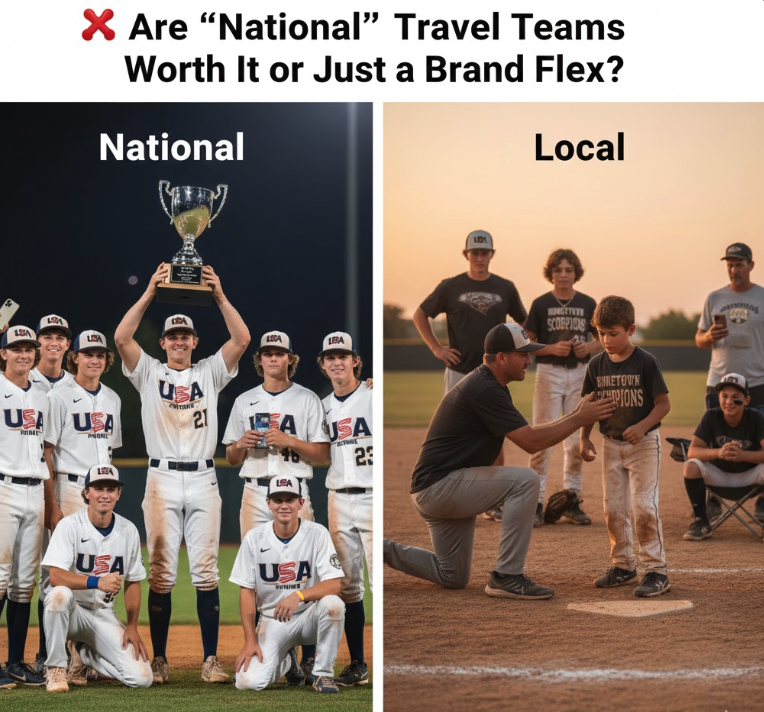
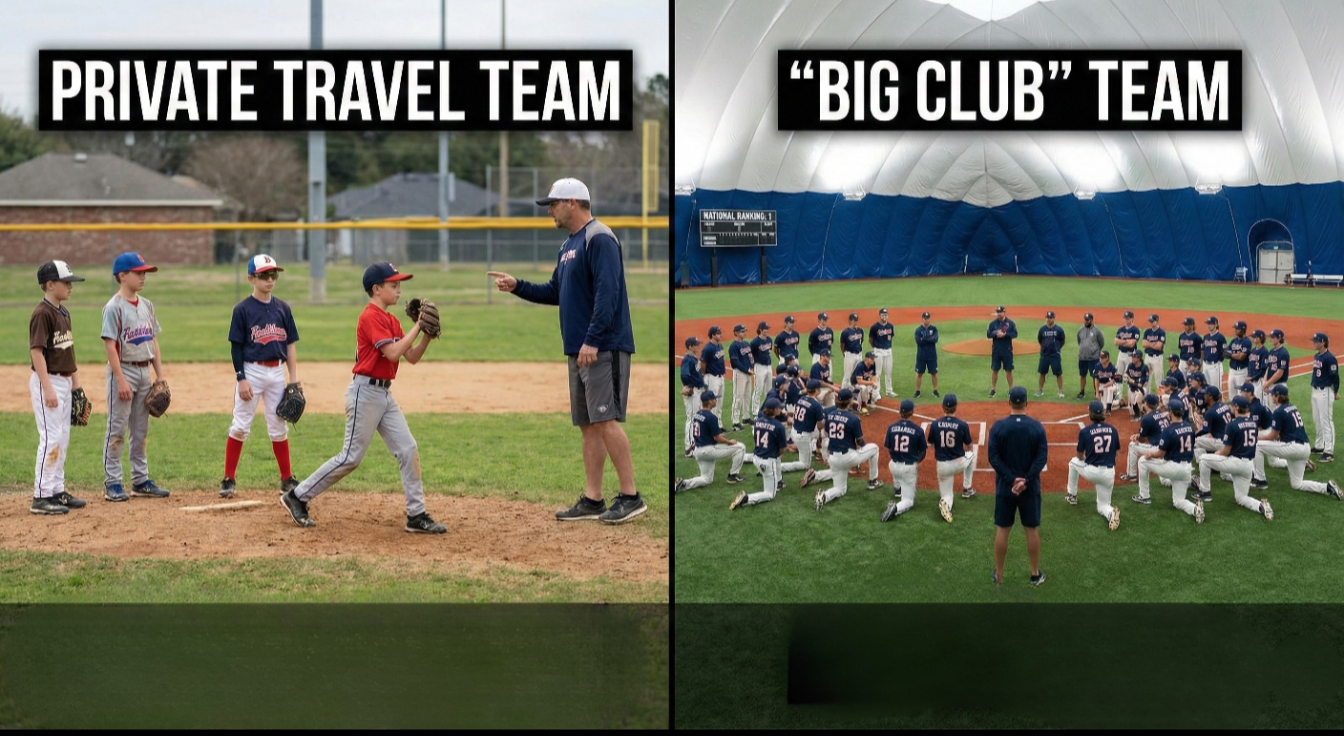
You’re on a private travel team with good coaches, decent facilities, and costs that don’t feel completely insane… but you keep hearing about the “big clubs.” The ones with the matching gear, the flashy social media posts, the big tournament schedules, and the reputation that makes parents wonder:
“Are we missing out?”
“Do those clubs actually develop better players?”
“Should we switch?”
It’s a fair question — and the answer isn’t a simple yes or no.
What a “Club” Usually Offers (That Private Teams Often Don’t)
High-profile clubs tend to have advantages that can matter:
More resources (indoor space, training staff, tech tools, strength programs)
Bigger talent pool (more tryouts, more teams, more competition internally)
Brand exposure (relationships with tournaments, showcases, recruiters)
Tougher weekly environment (practice pace and competition for roles)
That’s the upside. For some players, being in that environment forces growth — because the standard is high and the competition is constant.
But that doesn’t automatically mean a club is “better” for every player.
The Hidden Truth: Clubs Don’t Develop Players… Coaches Do
Here’s what a lot of families learn the hard way:
A club’s logo doesn’t fix swings.
A club’s Instagram doesn’t teach infield footwork.
A club’s “ranked schedule” doesn’t guarantee meaningful reps.
Development usually comes down to:
quality coaching
consistent reps
clear instruction
smart training habits
confidence + opportunity
A private team with strong coaches who actually teach fundamentals can develop players just as well — sometimes better — than a club that’s mostly focused on winning weekends or selling a brand.
Why Kids Leave for Clubs (Even When Their Team Is Solid)
When players jump from a private team to a big club, it’s often because of one of these reasons:
1) They want “more competition”
Sometimes that’s legit. Sometimes it’s just the perception that club ball is automatically higher-level.
2) They want the “path”
Clubs market a pipeline: better tournaments → better exposure → better opportunities.
3) Parents feel FOMO
When a few kids leave, it triggers the classic travel baseball domino effect:
“If they left… should we be leaving too?”
4) They want to say they’re on a big club
Let’s be honest — sometimes it’s status. Nothing wrong with wanting pride in your program, but it shouldn’t be the main reason.
The Biggest Risk of Clubs: Fewer Reps, More Politics
Here’s the part families don’t always think about:
Big clubs often have bigger rosters.
And with bigger rosters can come:
reduced playing time
unclear roles
more “guest players”
stronger politics
favoring older relationships or “known” players
A player can “upgrade” to a club and actually develop less if they’re stuck in limited roles and don’t get real reps. In baseball, reps are the currency. No reps = no growth.
So… Are High-Rated Clubs Developing Better Players?
Sometimes.
But not because of the name.
Clubs develop better players when they provide:
teaching-based practices (not just scrimmaging)
accountability and structure
smart training plans
pitching arm care policies
quality competition and real opportunity
Clubs are overrated when they provide:
hype without instruction
“exposure” without development
big rosters with low transparency
constant lineup favoritism
more money spent than value received
The Best Question Isn’t “Club or Private?” — It’s This:
Where will my child get the best combination of:
coaching
reps
competition
confidence
long-term development
If your current private team has strong coaches, indoor access, and affordable costs — that’s already a huge win. The question becomes:
Is your player still improving?
Are they being taught?
Are they getting meaningful reps?
Is the environment positive?
If yes… switching just to chase a brand might not be the move.
Final Thought
Travel baseball is full of labels — “club,” “national,” “elite.” At CurveballcCritiques.com, we believe the best development usually happens in the simplest way: good coaching, steady reps, and a player who’s bought into the work.
Before switching teams, don’t just ask, “Is that club better?”
Ask, “Is it better for my kid, right now?”
Because the right fit beats the biggest logo almost every time.