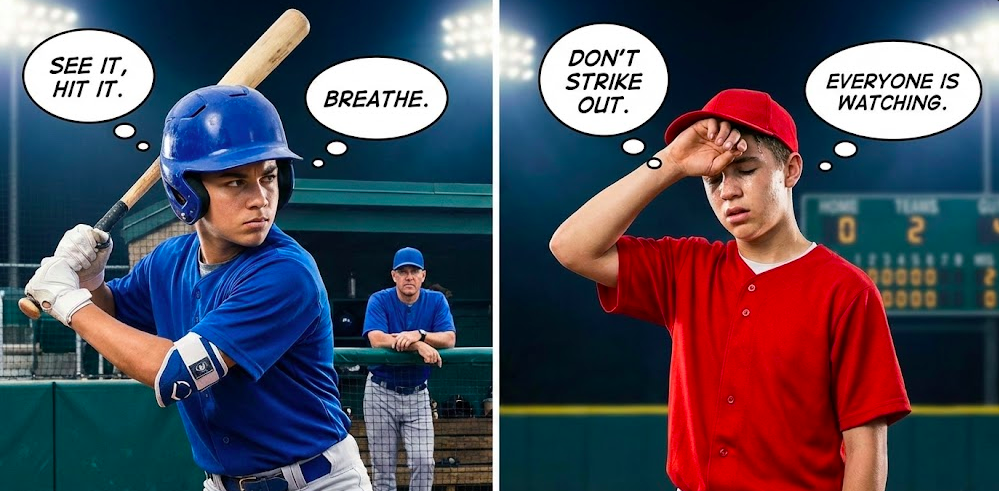
A lot of players feel this at some point: you’re not just trying to win the game… you’re trying not to disappoint anyone. Parents, coaches, teammates — sometimes even yourself.
And when that feeling kicks in, baseball can stop being fun fast. You start thinking about results before the pitch is even thrown. One bad at-bat feels like a big deal. One error feels like the end of the world. That’s the kind of pressure that can mess with your confidence and your focus.
If you’ve felt that, you’re definitely not the only one.
Why the Pressure Gets So Big
Baseball already has failure baked in. Even great hitters make outs most of the time. But pressure ramps up when it feels like every moment is being judged.
A few common reasons it happens:
You care a lot and want to prove yourself
You don’t want the “car ride home” to be miserable
Your coach reacts strongly to mistakes
You feel like playing time depends on being perfect
You’re comparing yourself to other players constantly
Sometimes nobody even says anything — you can just feel the expectations.
What It Can Do to Your Game
Pressure usually shows up in pretty predictable ways:
you get tight and your swing feels slow
you chase pitches you normally wouldn’t
you try to do too much (big swing, big hero moment)
you overthink everything
you play scared on defense instead of aggressive
Most of the time it’s not that you “forgot how to hit.” It’s that your body is tense and your brain is loud.
A Few Practical Ways to Handle It
1) Focus on stuff you can actually control
Instead of “I need 2 hits today,” try:
“I’m going to swing at strikes.”
“I’m going to have tough at-bats.”
“I’m going to run hard and play clean defense.”
You can’t control whether a line drive goes right at someone. You can control your approach.
2) Build a quick reset routine
The best players aren’t calm because they never feel pressure — they’re calm because they have something to fall back on.
Keep it simple:
one deep breath
one cue word (“smooth,” “see it,” “attack”)
step back in
It gives your mind something to do besides spiral.
3) Don’t make one game bigger than it is
This sounds obvious, but it’s real: a bad game doesn’t mean you’re bad. Baseball has rough stretches. Everyone goes through them.
If you can treat one at-bat like one at-bat — not a verdict — you’ll play freer.
4) If the car ride home is the problem… change the rules
A lot of pressure comes from post-game breakdowns. If that’s happening, it’s fair to set a boundary. Something like:
“Can we save feedback for practice?”
“After games I just need a ‘good job’ and some food.”
Doesn’t have to be a big speech. Just a simple request.
5) Make sure you still like baseball
Not every week is going to feel amazing, but if baseball is constantly stressful, it’s worth checking in. Sometimes the fix is small: fewer voices, less overtraining, more simple reps, more fun.
Final Thought
Pressure is part of baseball — especially in travel ball where it can feel like everyone’s watching and evaluating. The goal isn’t to never feel it. It’s to keep it from taking over your head and your body.
At CurveballCritiques.com we believe players play best when the focus is on competing, improving, and keeping the game in perspective — not turning every weekend into a scoreboard for someone’s expectations.